Top Ten Wild Foods to Gather in Winter
Written by Cab
Foraging through winter sounds like hard work; it's colder, it's wetter, you'd think that it's a pretty thankless task. And while it's true that you'll be wanting to wear a waterproof and a good pair of boots, it is surprising how many wild foods remain common through the dark winter months. That is especially true in these years of mild winters we have now; as I sit and re-write this article in the middle of December, we still haven't had a proper frost here in Cambridge, I'm still gathering sorrel and wild rocket. As the seasons get ever warmer, that kind of winter forage will be more and more common.
I'm not setting out to give an exhaustive list of things to gather through winter. I've just picked out some good, fairly common ones; a couple of fruit, some fungi, and some greens (a balanced diet!). I hope that after reading this article you will be encouraged to wander out and see what's growing. You could be very surprised.
(1) Oyster mushrooms (Pleurotus ostreatus, Pleurotus cornucopiae)
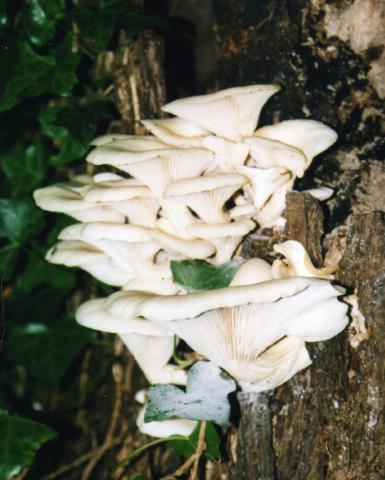
The oyster mushroom is one of my favourite winter forages, although they can be found at any time of year. I've got a personal tradition of looking for as near as I can to the longest and shortest days of the year, and as often as not (if summer has been wet!) I'll manage that.
Now, that doesn't mean that oyster mushrooms are all hugely prolific all year. It isn't usually the same log or tree stump (the habitat of the oyster mushroom) that is fruiting on both days, more often it's a different patch. That's because individual patches seem to have different 'stress' responses; some to frost, some to dry spells, etc. And generally it's a frost response that gets them going in winter.
So look for them especially after a frost; anything from two days to a week after a hard frost. If the weather has been a little more temperate, you can expect to find oyster mushrooms fruiting. Use wild oyster mushrooms in just the same way as shop-bought ones; they're a tasty, textured mushroom suited to stir-frying, stews and soups.
(2) Blewits (Lepista nuda, Lepista saeva)

Field blewit, otherwise known as the bluey or bluebutton

Wood blewit; the younger specimens like this are easier to identify, especially backed up with a spore print, than the older ones. At least until you get your eye in.
I think of all of the mushrooms I've picked, blewits might be my favourite. It isn't just because of the flavour (although that's intensely mushroomy with some vague floral undertones). It's more because of where and how they grow.
Field blewits (Lepista saeva) are common on grassland, in parks, gardens, etc. across most of England from around October through until January (sometimes a little earlier, sometimes a little later). They're unassuming toffee-coloured chaps that grow prolifically in rings, the caps ranging from a centimetre or two across anything up to 15 centimetres or more. It isn't until you upturn one that you see the violet stem (this fades in bigger, older specimens), but it's when you lift it to your nose that you learn what blewits are all about; the rich, earthy, floral smell that will perfuse anything you cook with them. And, best of all, they're nigh on indestructible. They survive frost, they cope with snow (they'll be fine after it melts and runs off them), rain just makes them wet... and that means that no matter what winter throws at you, you can find some!
Wood blewits (Lepista irina) are more delicate, but more intensely violet in colour (fading to brown as they age), and if anything even more floral.
Blewits are a great accompaniment for meat dishes. They go very well with beef, pigeon, hare or rabbit. I like to exploit their aromatic flavour by matching them up with juniper berries, sage and thyme. In the East Midlands it is traditional to stew them with milk; make a sauce by softening some onions, add in the chopped stems, cook until soft, and then make a white sauce around this, with the sliced mushroom caps added and cooked in for half an hour. Season well, and serve on a bed of mashed potatoes.
(3) Nettle (Urtica dioica)
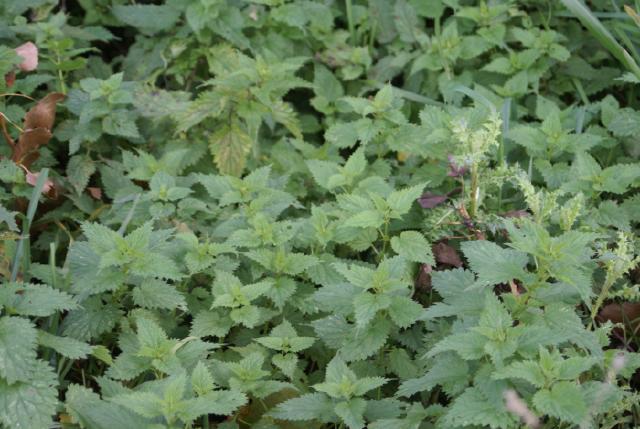
I know what you're thinking. Nettles? In Winter? Those unappealing dried up stems?
That isn't what I'm talking about, of course. Look more closely at the clumps of stinging nettle, and you may be pleasantly surprised to see new, fresh growth at and near the base. It will be intensely green, soft (still stingy!) and lush, and it makes capital eating.
Gather your nettles with care; wear gloves when picking and preparing them or you'll regret it. Wash them, removing any bits of old stem or any tough material, and then cook them through rather like spinach, adding a little nutmeg. Or use them in soup. They're tasty, and very nutritious.
(4) Chickweed (Stellaria media)

This is one of my favourite greens, and it can be found poking around the edge of fields, vegetable patches, pretty much anywhere there's disturbed ground. Its little white flowers and tiny little green leaves belie the fact that this plant has a superb, succulent texture and a flavour not unlike a cross between cress and spinach.
I eat this one raw, in salads, more or less all year. It is of course especially useful in winter when there is so little else around. Mixed with some lettuce and sorrel, it's a great ingredient in a winter salad.
(5) Dandelion (Taraxacum officinalis)
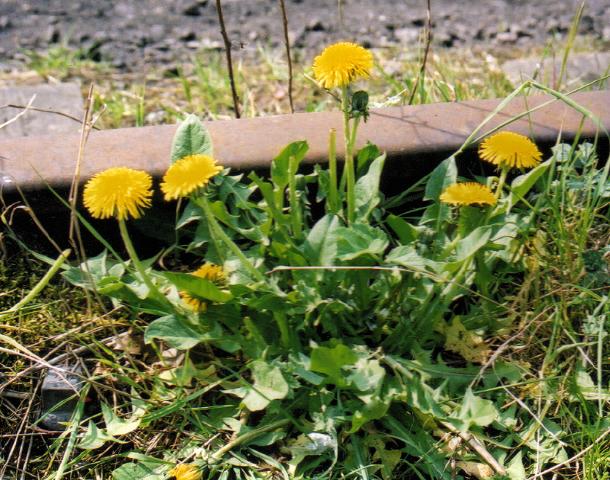
We all know the humble dandelion. Many people seem obsessed with eradicating it from their lawns and flower beds, but for me it's a welcome visitor. It's a tasty, productive, and versatile little weed.
In Winter, you won't find many flowers (although keep your eye open and likely as not you'll find it flowering at any time), but you'll find plenty of leaves. And this is also the time to dig up the roots.
The leaves will be a little bitter; mix them in with some good lettuce and sorrel in a salad, and make sure that you sample your dandelion leaves before serving, just to make sure you haven't picked any really nasty ones. Serve the leaf salad with croutons and crispy fried slivers of bacon, and you've got a filling little side dish.
Dig roots up in early winter, and give them a good clean. Then you can dry them out in an oven, grind them up and roast them for dandelion coffee (tastes just like French coffee with chicory, pre-sweetened and kind of milky. Not to my tastes, but a handy caffeine-free drink nonetheless). Alternatively you can fry them in chunks in a little oil, add some soy sauce, and cook down till softened.
(6) Rose (Rosa canina and related species)

Rose hips start ripening in Summer, and through Autumn and into Winter you'll find them slowly bletting (softening due to the release of enzymes by the fruit itself) on the bushes. They're a superbly versatile fruit that is much under-utilised, I suspect due to the traumatisation of an entire generation with awful, sickly sweet rose hip syrup.
Any quick web search will reveal dozens of recipes for rose hips. From the infamous syrup, through to jellies, jams, and puddings all the way to some savoury favourites of mine such as rose hip soup. Dried they make a fine herbal tea.
Just make sure that, whatever you cook, you get rid of the seeds. Normally that's achieved by cooking to a pulp and straining, but make absolutely sure that you do not crush them as that imparts a rather unpleasant, bitter tang to the finished dish.
(7) Medlar (Mespilus germanica)
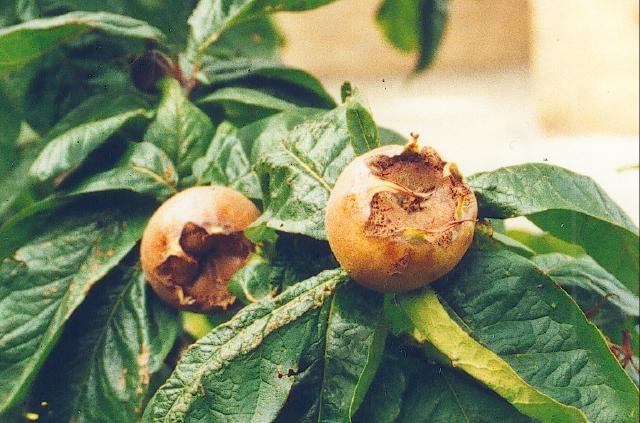
The medlar is a not-uncommon little deciduous tree found in the Midlands and South of Britain, being a little bit less common further North. Its fruit is an unappetising looking thing, kind of dull green to brown, with pointy fronds on the end of it. All in all not something you'd expect to be good to eat. It doesn't even ripen properly in Britain.
The tree eventually gives up on its fruit. Some time around October or November the medlars start to soften on the tree, to ‘blet', at which point they turn brown, pulpy, and sweet. Sort of like stewed pears. And all of a sudden they're delicious.
I like to eat them just as they are, squeezing the flesh out and leaving the skin, spitting the hard stones out as I eat them. But they also adapt well to pies and puddings. Picked earlier in the year before they blet, they make a super jelly, but for me that wastes what is otherwise a rare treat; a fruit that can be picked and eaten straight off the tree right through to December in a good year.
(8) Cow Parsley ((Anthriscus sylvestris) and related species)
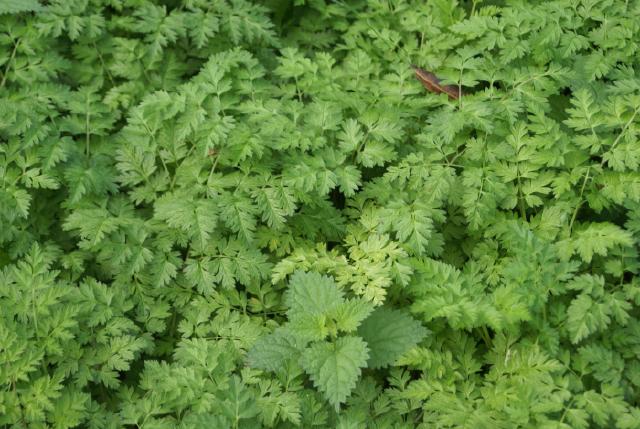
Cow parsley - common as muck, but until you get your eye in, leave it alone!
Common as muck, but dangerously similar to other wild, poisonous umbellifers, I wouldn't recommend picking it to anyone who isn't entirely confident in their ability to distinguish it from the water dropworts, rough chervil, and hemlock. But if you are up to it, it's a great wild plant.
It forms little crowns of leaves in winter. You'll find it even through the snow. It is the nearest wild relative of chervil, as you can tell by its flavour. It's a super addition to herb risottos, herb breads and green salads, and I also use it to flavour potato soup.

Sweet cicely, an aromatic, sweet relative of cow parsley
Further West and to the North (and sporadically in the South and South East) you'll find sweet cicely (Myrrhis odorata) growing too. You find it less often in winter, but you do get it. The sweetest, most aromatic of the wild umbellifers.
(9) Ground Elder (Aegopodium podagraria), and Alexanders (Smyrnium olusatrum)

Ground elder poking its nose up through the leaves and ivy in early December
Ground elder is a weed. It's a really common, evil weed that is a nightmare to eradicate from your garden. It's a common feature of Radio 4's ‘Gardeners Question Time'; panellists will discuss how exactly to eradicate it, and almost always the solution is to nuke it with glyphosate (except for Bob Flowerdew, who of course suggests that you keep digging it out for the rest of your life). I, however, would like to suggest a different solution. Eat it. With gusto. Sooner or later (probably later), if you keep taking the green leaves off it to eat, it'll die.
The Romans, who grew ground elder as a vegetable, introduced this weed along with several other wild umbellifers to the British Isles. Until the late Middle Ages it was found in vegetable and herb gardens all over the country, until the British decided that they really didn't like vegetables with flavour and inexplicably went off it.
And it is a superb green vegetable, but a sod to kill off. Use that to your advantage; pick the young greens throughout the year, making the plants throw more up. Use the leaves in salad when they're young and soft and cook them like cabbage (steamed gently) as they age. Even into winter, you'll find them growing happily in woodlands and hedgerows, and as long as they haven't got too tough they make fine eating.

Alexanders, as you see them in Winter
Another of the big, leafy umbellifers you'll find (most especially around the coasts but sporadically inland) is Alexanders. Another Roman introduction, it is a biennial or short-lived perennial plant that seeds freely on cliffs and in hedgerows near the Sea in much of the South of Britain. It's the tender, pale green leaves that form rosettes after the flower stalks have died down in Summer that you'll be picking through the winter. Be sparing, of course. Leave enough on the plant to see it through the harsh weather.
Use it in the same way as ground elder, but if anything it's even more aromatic.
(10) Apple (Malus sp.)

Little red crab apples - these ones were still on the tree at the end of January
You're familiar with crab apples, of course, and you all know what ordinary apples look like. But did you ever go looking for crab apple trees in winter? It's astonishing how long the fruit cling to the trees, sometimes persisting until the storms of January knock them off.
The sheer variety of apples you'll find growing wild is staggering; from hard little balls of acid, right through to aromatic, sweet scented giants. You can find a range of apples growing wild, right into the winter.
And as long as they're intact, they'll be useful to you. Crab apples may be tart, but use that to your advantage. I like to stack them under a joint of pork, mashing them in the juices at the end with maybe a little brown sugar to make a great roast apple sauce. I soak them in gin, with sugar, to make a rather savage drink to take to parties. They add in with rose hips or rowans to make a jelly. Be creative and you'll find no end of uses for them. |